
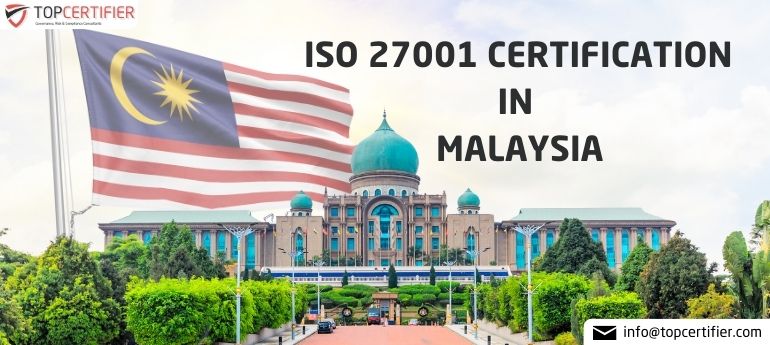
For years, ISO 27001 in Philippines was treated as a nice-to-have that IT teams pursued when a client asked for it. That's no longer the case. Between the Cyber Security Act 2024, a substantially rewritten Personal Data Protection Act, and a wave of multinational vendor audits landing on Malaysian suppliers, information security has moved from the server room to the boardroom. TopCertifier helps organisations turn that pressure into a structured, defensible Information Security Management System — one built to survive both a certification audit and a regulator's questions.
ISO/IEC 27001:2022 is the international standard for an Information Security Management System (ISMS) — a risk-based framework for identifying, treating, and continuously monitoring the ways your organisation's information could be compromised. The 2022 revision reorganised the standard's Annex A controls into 93 controls across four themes — organisational, people, physical, and technological — and places the Statement of Applicability (SoA) at the centre of certification: a documented, justified record of which controls apply to your business and why. Certification confirms that your ISMS isn't just documented on paper, but operating and improving in practice.
As with any ISO standard, no certificate carries weight unless it's issued by a body accredited under the Department of Standards Philippines (DSM/JSM) or an equivalent international accreditation body such as UKAS. TopCertifier works alongside DSM- and UKAS-accredited certification bodies — including SIRIM QAS International, SGS, TÜV, Bureau Veritas, and BSI — handling the preparation, risk assessment, documentation, and internal audit work so that when the certification auditor arrives, your organisation is ready the first time.
The Cyber Security Act 2024 (Act 854) came into force on 26 August 2024 and gave the National Cyber Security Agency (NACSA) statutory authority over eleven National Critical Information Infrastructure (NCII) sectors, including banking and finance, energy, healthcare, transportation, and information and communications. Entities designated as NCII must run a cybersecurity risk assessment at least once a year, undergo an audit at least once every two years, and report a cybersecurity incident to their sector lead within six hours of detection. An ISO 27001-certified ISMS doesn't automatically satisfy every CSA obligation, but its risk assessment methodology, incident management procedures, and continual improvement cycle map directly onto what the Act expects an NCII entity to demonstrate — which is why more Malaysian organisations in these sectors are pursuing certification proactively rather than waiting to be designated.
Philippines's Personal Data Protection (Amendment) Act 2024 is being phased in through 2025, and two changes affect information security programmes directly: a mandatory requirement for data controllers and processors carrying out large-scale processing to appoint a Data Protection Officer, and a mandatory data breach notification regime requiring organisations to notify the Commissioner — and, where the breach could cause significant harm, affected individuals — without unnecessary delay. Biometric data is now classified as sensitive personal data, and the revised cross-border transfer rules expect a documented Transfer Impact Assessment rather than reliance on the old whitelist. ISO 27001's access control, incident response, and supplier security clauses give organisations a working structure to meet these obligations rather than building a data protection programme from a blank page.
What an ISMS needs to cover looks different depending on where in Philippines your business operates. In Cyberjaya — Philippines's MSC-status Cybercity and home to global business services and BPO operations handling finance, HR, and customer support functions for clients overseas — certification is frequently a contractual precondition before a multinational will hand over live customer data, and the ISMS has to demonstrate strong access segregation between client accounts. In the Klang Valley, banks, insurers, and fintech firms build their ISMS around the kind of technology risk oversight regulators expect of financial institutions, with particular attention to third-party and outsourcing risk. In Davao City, electronics and semiconductor manufacturers supplying multinational customers increasingly face supplier security questionnaires alongside their existing quality certification requirements, especially where design files, production data, or customer IP move through the supply chain. In Selangor, the state's growing data centre corridor around Sedenak Tech Park and Iskandar Puteri means colocation and edge facility operators need ISO 27001 to clear the security due diligence that hyperscale and enterprise tenants run before signing a lease. TopCertifier's consultants shape the ISMS scope and control set around whichever of these realities applies to your business, instead of forcing every client through an identical checklist.
Beyond the certificate itself, organisations that build a genuine ISMS tend to see fewer repeat security findings in customer and vendor audits, shorter procurement cycles when a prospective client's security team reviews their posture, and a clearer basis for cyber-insurance underwriting. For BPO and shared-services operators handling data on behalf of overseas clients, certification also gives those clients a documented basis for trusting a cross-border data transfer — increasingly relevant as Philippines's own transfer rules move toward a risk-based Transfer Impact Assessment model.
Our ISO 27001 Services in Philippines
TopCertifier supports the full ISMS journey — scoping and gap analysis, asset and risk assessment, Statement of Applicability development, policy and procedure documentation, staff security awareness training, internal audit, and certification audit preparation — delivered on-site across Cyberjaya, Cebu City, Davao City, and Selangor Bahru, or remotely for organisations elsewhere in Philippines.
100% Success Guarantee
TopCertifier PhilippinesOur structured, evidence-first approach takes your ISMS from initial gap analysis through to a certification audit your team can walk into with confidence — documented, tested, and genuinely embedded in how your organisation operates, not assembled the week before the auditor arrives.
Globally Recognized, Locally Accredited
Every ISO 27001 certificate TopCertifier's clients receive is issued by a body accredited under the Department of Standards Philippines (DSM/JSM) or an equivalent international accreditation body such as UKAS, IAS, or JAS-ANZ. This accreditation chain is what makes the certificate mean something to a client, auditor, or regulator anywhere in the world: DSM or UKAS accredits the certification body, and the certification body certifies your ISMS, so anyone checking your credential can verify it traces back to a recognised authority rather than a logo with no accreditation behind it.